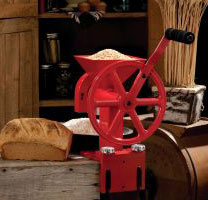

Using your GrainMaker Mill
When hand grinding, the mill must be secured to your counter or work surface by either bolting through the base or using the optional clamp. Motor driven mills must be bolted securely before attaching the appropriate belt - no exceptions!
The hopper holds a full four cups of dry material - see the list of grains below or experiment with your own combinations. Give the handle a few turns to test both the coarseness of the finished product and the amount of resistance you feel. You can correct/adjust the coarseness or fineness of the finished product by loosening or tightening the adjustment knob. To make it easier to grind very small grains, it may be necessary to take out the stainless steel auger and replace it with the coil auger.
Grinding Whole Grains
Always buy the highest quality grains and seeds you can afford; the quality of the finished product is never any better than the raw material you use. Here are some popular choices:
Wheat - Hard red spring wheat has a high protein content, but can make a really dense loaf of bread. Mix with soft white spring wheat for a good all-purpose flour.
Peanut butter - It takes hardly any effort to make your own peanut butter using roasted, salted or unsalted peanuts. No extra oil is necessary. It helps to have a spatula handy! Wash burrs in soapy water when finished.
Corn - Popcorn makes the best cornmeal/flour, because it is very dry and hard.
Rye - Make a beautiful rye flour for bread or crackers.
Rice - Makes a great flour, a good alternative for people with gluten sensitivity.
Coffee - Make any grind for the way you like to brew coffee.
Flax seed - This tiny seed packs a big punch as an anti-oxidant. Crack or grind it easily.
Beans- Ground legumes are awesome! Grind fava beans to make a gluten-free flour substitute. And to utilize all the protein in wheat, add legumes to add lysine. A 4/1 ratio boosts usable wheat proteins by 33%.
Order Now